Expected more from 'A Little History of Poetry' by John Carey
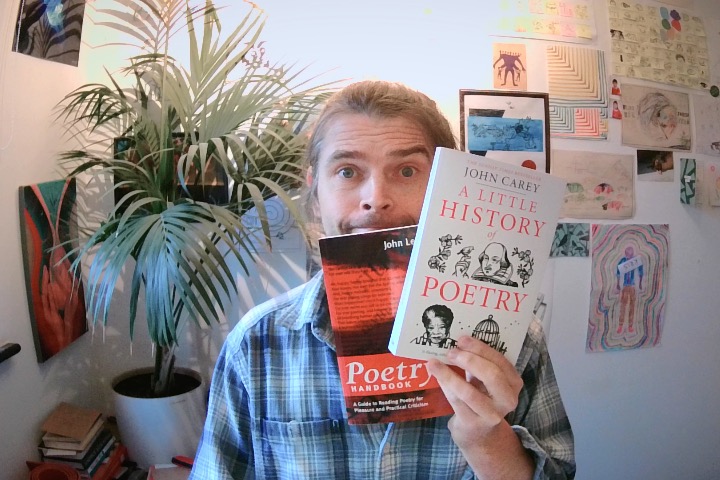
Summary
People who know much more about poetry than I do have reviewed this book on Goodreads as a bit opinionated. The average rating is 3.7, which is something I can agree with for two reasons.
First, I think the title is misleading; the book focuses on English poetry, e.g., there is no mention of Hungarian poetry at all (e.g., Petőfi or József), which might only be important to me since I have been trying to write poetry in Hungarian. I guess the book should really be titled something like A Little History of Poetry in English + Some Others Worth Mentioning. The current title would be okay, of course, if there was some kind of introduction that explains the narrative of the book – that there will be many poets and languages left out, and why.
The second reason is that while it’s written really well and is also quite enjoyable to read, I often felt there were not enough connections between the chapters or between the different schools (movements) of poetry. I would have preferred more signposting. I think what I really would have liked is some kind of diagram or a visual timeline in that missing introduction, on which we could see how the different schools of poetry coexisted with each other in different countries, with different historical events linked to political, religious, and economic changes.
Booknotes
p.1 I referenced Gilgamesh in one of my silly little poems for a poetry marathon. Why? Maybe I wanted people to think I know the history of poetry.
p.7 Skywalker was just studying the Greeks at school, we even watched the two-part The Odyssey (1997) TV film. We tried the TV series starting Kevin Sorbo as well – we started with Hercules and the Amazon Women (1994) – but it felt too sexist e.g. how the old Zeus seduced a young warrior girl in the first episode.
p.11 Homer’s work survived translation “partly because of the simplicity, speed and directness of his narrative technique”. Does this mean I have to write simple Hungarian poems if I want to easily translate them into English?
p.16 ‘Carpe diem’ comes from Horace who became the “poet laureate” of the Augustan age. This was mentioned in the film Dead Poet’s Society (1988).
p.24 Dante has a relationship with a dead woman’s spirit, whom he was in love with when they were children. But he never mentions his wife in his poetry, who gave him seven children. Why?
p.45 The name for mixed language poetry is ‘macaronic’. Maybe I could write something like this? Mix Hungarian and English… is this a niche in a niche?
p.59 The poem that argues with a women so as to have sex with her involves a flea in John Donne’s The Flea. The insect bit both of them, so their blood is mixed already, they can have sex. He is “celebrated as the greatest English love poet” (p.62).
p.65 “The seventeenth century was an age of astonishing diversity in English poetry. Donne dominated at the start, Milton towards the end. As poets they are different from each other in every possible way, and the poets who emerged in the intervening years are wholly and unmistakably individual too. This is a great change from the Elizabethan age, when one sonneteer or song-writer can easily be mistaken for another. Where did the new sense of individuality come from? One suggestion is Protestantism, which frees the individual believer from conformity and encourages self-examination. Another suggestion is London. It was the first metropolitan culture England had known, and city life, which surrounds you with strangers, intensifies your sense of difference.” … “The individual differences encouraged by Protestantism dominated seventeen-century Britain’s religious turmoil (p.75)” Now these are the parts I enjoyed them most in the book. Here we understand how poetry evolved and why.
p.82 John Milton, author of Paradise Lost, the books says is considered the second best English poet after Shakespeare.
p.90 The Augustan Poets often wrote in ‘heroic couplets’, which has ten-syllable lines, rhyming in pairs. How does this make the poem sound more heroic? The book doesn’t explain why these couplets sound heroic so I asked Gemini: “It’s because the structure is very stable, balanced, and “authoritative.” Because it clicks shut at the end of every two lines, it sounds like the poet is stating absolute truths.”
p.101 The first known African-American woman poet, who was also an ‘ex-slave’, was Phillis Wheatley. “No male poet can match Wheatley’s extraordinary story. But one who climbed through the barriers of the 18th century class structure was Stephen Duck.” Started as a farmer. The other ‘peasant poet’ was John Clare, who also wrote about work, nature. I liked when the book mentioned poets who weren’t born into rich families.
p.103 There are poets who became famous even though they only published 13 poems e.g. Thomas Gray.
p.120 John Keats was also coming from a poor background. He became a medical student. He was mocked by contemporary critics partly because of his social class. He was called a ‘cockney’ poet.
p.125 “Shelley advises meeting force with passive resistance (his idea of civil disobedience influenced Tolstoy and Gandhi).” This is probably not in line with with what my (now ex-) friend shared with me about the paradox of tolerance proposed by Karl Popper.
p.130 The romantic poet William Blake “distrusted pure reason, he also distrusted the Enlightenment and science, believing them hostile to the power imagination gives you.”
p.134 Another poet coming from a labouring (farmer) family was Robert Burns. “His great gift is authenticity. Other Romantics sympathised with the working class; he belonged to it.”
p.138 After reading Goethe’s The Sorrows of the Young Werther many people committed suicide and so the book was banned in many countries. I might have read a bit more about Faust since I don’t seem to understand why the angels rescue him from the demons.
p.145 Before Pushkin, “there was virtually no Russian literature”. How is this possible? “Upper-class Russians spoke French and despised their native language.” Is this true? This is probably an over-simplification by Carey, right? Pushkin’s works influenced Dostoevsky.
p.155 The books says that “Many, including it seems Tennyson, found that their Christian faith could not survive such knowledge” e.g. “that the earth was millions of years older than the Bible suggested.” On p.159 we read about Matthew Arnold’s poetry, which e.g. in Dover Beach “contemplates the 19th century’s gradual loss of religious faith”.
p.155 There have been many poets who came from prosperity e.g. Robert Browning. He didn’t need a job.
p.160 Elizabeth Barrett Browning, although coming from a rich family linked to sugar plantations, campaigned against slavery. When slavery was abolished the family’s money was severely affected. Her last poem, A Musical Instrument feels like an apology for her more cruel and violent poetry, in favour of her gentler one. When people are dying do they want to make sure they didn’t upset anyone? Probably not in line with the “Do not go gentle into that good night…” lines I will quote soon.
p.163 The Bronte sisters used male pseudonyms to publish poems. Emily apparently was raging sometimes e.g. hurting her dog.
p.165 Christina Rossetti, in her later years volunteered at a former prostitutes refuge. Her most famous poem Goblin Market is excellent work. It’s a feminist poem that teaches “how love between women can save them from the wicked temptations of men.” The poem is likely inspired by the stories she heard at the refuge.
p.169 You can sometimes read that poets had relationships with younger people e.g. the bisexual Walt Whitman, who “formed intense relationships with men and boys…”. There were other, heterosexual, examples earlier in the book as well and I wonder how people today judge these relationships e.g. do we separate the art from the artist and then celebrate the art but not the artist who (likely) did something unethical? Later (p.181) we read about Lewis Carroll’s “weakness for scantily clad little girls”, which has been an ongoing argument since between scholars and now layman on the internet. Carey’s seems to be a very controversial claim and as far as I know most biographers cite Carroll’s fascination with the “little girls” a motif and not a “weakness.” I looked for feedback online and was suggested to check out “presentism” which is something like the act of judging historical figures by modern moral standards. It’s a huge debate in literary circles.
Regarding Whitman, the book seems to suggest that he didn’t care much about what other people thought of him:
I do not trouble my spirit to vindicate itself or be understood,
I see that the elementary laws never apologize.
Another quote:
Do I contradict myself?
Very well then I contradict myself,
(I am large, I contain multitudes.)
Whitman also wrote the poem O Captain! My Captain! which was featured in the film with Robin Williams, the Dead Poet’s Society (1988). I really liked that film… maybe I should write about it later.
p.177 “In the closing decades of the 19th century European culture began to fragment. There were various reasons. In 1871 that shattering defeat of France in the Franco-Prussian War ominously redrew the power-map of Europe. Throughout the century, industry and commerce had transformed life in cities, and it seemed to many that the arts were being side-lined. Europe’s population more than doubled, and people began to complain of crowds and their power. Another development was the spread of education. By 1900, state-sponsored elementary education created mass literacy, which brought with it mass-circulation newspapers and magazines. Writers’ reactions varied. Some welcomed the new market for their work. Others despised it.” Baudelaire didn’t really like other people, or maybe he didn’t like poor people, I am not sure. He liked his luxury, although his parents didn’t give him much money. He rebelled against his parents, drunk, smoked weed, etc. Carey says his work is full of self-pity.
p.179 The Symbolist poets followed – I guess the technical inventions – of Baudelaire. These poets use symbols e.g. the bird in Baudelaire’s poem titled The Albatross is the poet (so it’s a metaphor), but the book says their main goal was to “break away from all previous poetry.” Arthur Rimbaud’s aim with his poetry was “to reach a new kind of truth”. He wrote:
The idea is to reach the unknown by the derangement of all the senses.
I wonder, is this connected to shamanism or how shamans ‘derange the senses’ to access an altered state?
His work then is also linked to synesthesia. “He also abandoned coherent meaning, so that his poems can read like the result of free associations - which Freud was developing in Vienna, around the same time, for psychoanalytic purposes.”
Paul Valéry Ars Poetica suggests to be incoherent – as a poetic principle:
Let your verse be aimless chance.
He said that the musicality of the poem is more important than its meaning. Is this in any way in line with what visual artists were doing at the time? What was the philosophy, the historical change at this time?
p.181 Dylan Thomas wrote:
Do not go gentle into that good night,
Old age should burn and rave at close of day;
Rage, rage against the dying of the light…
Yes, I have heard this before and it reminded me of a Petőfi poem:
Egy gondolat bánt engemet:
Ágyban, párnák közt halni meg!
One thought keeps going round my head:
The thought of dying in my bed! (source)
The last part of this chapter (Shaking the Foundations) mentions Théophile Gautier who is famous for “art for art’s sake”. Wikipedia says that it means “that ‘true’ art is utterly independent of all social values and utilitarian functions, be they didactic, moral, or political.” Is this a bit like absolute music? Does this allow Hitler’s works to be celebrated i.e. by separating the art from the artist? Crazy.
p.189 The book also says that A.E. Housman believed that “Meaning is of the intellect, poetry is not”, and that “Poetry is not that thing said but a way of saying it.”, however the way of saying poetry is often inseparable from meaning or is it not? I kind of understand what is meant here, but would be interested in further clarification. The books also says that he didn’t find a publisher which damaged his confidence. I can understand that. I think many can. Keep grinding!
p.193 When the book talks about the Georgian Poets, it says that Edward Thomas and Robert Frost “wanted poetry to be less ‘poetical’, and to follow the cadence of ordinary speech. Frost suggested the best place to hear it was behind a door where you could not distinguish the words but only the stresses and intonations.”
Ezra Pound had an interesting life e.g. he was linked to fascism, apparently comparing Hitler to a saint like Joan of Arc. On p.219 we also learn that his child Mary – I can’t remember how many he had or with how many women – was given to a peasant woman to bring up. And then they had another child, a boy named Omar, who was also given away to his first partner/wife, Dorothy. Why? Is this normal? He had interesting views on capitalism e.g. that it made money out of money, and that this money should be replaced with a currency that cannot be hoarded e.g. vegetables. His Cantos is long but seems to be his most ‘important’ work. Some critics dismissed it, e.g. Robert Graves, with contempt.
p.239 In the Getting Over Modernism chapter, we get to know Marianne Moore. The story of Moore’s poem titled Poetry is very interesting. Its length changed over time, it became shorter. It also seems to be a good argument for writing poetry. Being okay with a poem changing over time I think was also part of modernism. She also wrote about nature and is famous for her poems about animals. I somewhere else read or saw (maybe YouTube) that she never married but perhaps was waiting for T.S. Eliot to ask for her hand. She was respected in her community and was also famous for being the editor of a famous journal called The Dial.
p.269 We get to know the English ‘Movement’ poets who ‘believed poetry should make sense, and should communicate with ordinary people, not just highbrows. They reject modernism. “Movement poetry is capable of argument because it employs reason, whereas for some theorists and practitioners of modernism reason and logic inherently unpoetic.” This reminded my of the musical with Hugh Jackman titled The Greatest Showman (2017).
p.283 In the chapter called Poets in Politics, we learn that in Russia, in the first half of the last century, Anna Akhmatova found it too dangerous to keep written copies of her poetry, so she memorized them and burnt the papers.
In the last chapter of the book (p.289), we get to know the Irish Seamus Heaney, who refused to write political poetry and as a ‘peacemaker’ won a Nobel Prize. We also get to know the American Maya Angelou, “a spokesperson for black women, and civil rights activist alongside Martin Luther King Jr. and Malcolm X, … she earned her living as a cook, nightclub dancer, sex worker, singer and actress.” She was also abused as a child and later in a poem says that she cannot write without resentment. We also get to know Mary Oliver, who according the the New York Times was a best-selling poet. She was also abused as a child. Cary wrote that “She believes that humans are alienated by reason and culture from the natural joy of birds and animals, and her delight in nature is not diminished by a realisation that it is a world of predators and prey.” Food for thought.
I will start with the other book in the photo above, John Lennard’s The Poetry Handbook soon.